
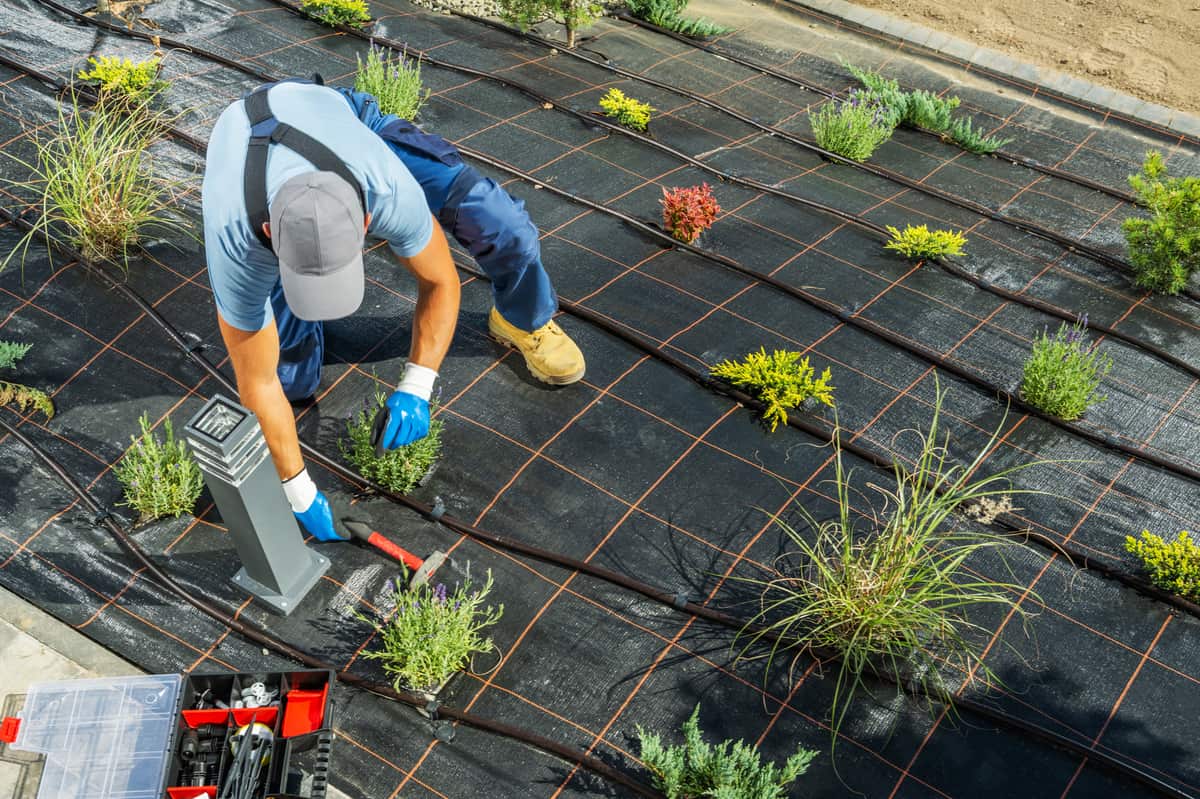
When homeowners ask me how to water beds and borders without wasting water, the conversation usually comes down to two low-volume options: drip emitters and micro emitters (often called micro-sprays or micro-sprinklers). Both run off the same drip tubing, both sip water compared to overhead sprinklers, and both have a place in a Seattle yard — but they water very differently. Here is my breakdown of how each one works, where each one wins, and how to choose.
The Two Contenders
Drip emitters release water slowly — typically 0.5 to 2 gallons per hour — at a single point, right at the base of a plant. Water soaks down into the root zone with almost no evaporation and no wet foliage. Emitters come as individual point-source drippers you punch into tubing at each plant, or as drip line with emitters built in at set spacing.
Micro emitters (micro-sprays) are tiny sprinkler heads on short stakes or risers. They spray a gentle fan or mist over a small radius — usually 3 to 10 feet — at roughly 5 to 25 gallons per hour. Think of them as miniature sprinklers for beds: they wet a surface area rather than a single point.
Side-by-Side Comparison
| Factor | Drip Emitters | Micro Emitters (Micro-Sprays) |
|---|---|---|
| How water is delivered | Slow soak at one point, straight to the roots | Light spray over a small circle or fan |
| Water efficiency | Highest — almost nothing lost to wind or evaporation | Very good — some loss to wind and evaporation on hot days |
| Best for | Shrubs, trees, perennials, vegetables, containers, hedges in a row | Groundcover, flower beds, densely planted borders, new plantings |
| Coverage pattern | One wet spot per emitter — spacing must match the plants | Overlapping spray patterns cover an area evenly |
| Foliage wetness | Leaves stay dry — less fungal disease | Foliage gets wet — can encourage mildew on susceptible plants |
| Clogging | Emitters can clog with sediment or mineral buildup; filters matter | Larger orifices clog less often, but spray patterns distort when partially blocked |
| Visibility | Tubing hides under mulch; nearly invisible | Small heads on stakes are visible above mulch |
| Adjusting as plants grow | Add or move emitters as root zones expand | Fixed pattern — swap heads or add stakes for more coverage |
Where Each One Wins in a Seattle Yard
Choose drip emitters for:
- Hedges and foundation shrubs — A drip line with built-in emitters waters a whole row evenly and disappears under bark.
- Trees and large shrubs — Two to four emitters per plant, moved outward as the canopy grows, deliver deep water where the feeder roots are.
- Vegetable gardens and containers — Precise delivery, dry leaves, and far less water between rows where weeds would love a drink.
- Slopes — Slow application soaks in instead of running off — a real issue on Seattle's hillside lots.
Choose micro emitters for:
- Groundcover beds — Hundreds of small plants are impractical to drip individually; overlapping micro-sprays cover the whole bed.
- Flower borders and new plantings — Even surface moisture helps shallow-rooted annuals and fresh transplants establish.
- Mixed beds with tight spacing — When plants are packed closer than emitter spacing, spray coverage fills the gaps.
The Seattle Factor
Our summers are drier than our reputation — July and August can go weeks without meaningful rain, and that is exactly when beds need steady water. Both systems shine then, but two local conditions matter. First, much of Seattle sits on clay or hardpan that absorbs water slowly: drip's slow delivery matches clay's intake rate, while micro-sprays need shorter, repeated cycles so water soaks in instead of puddling. Second, our water is soft, so mineral clogging is less of a problem here than in hard-water regions — but a filter at the head of the system is still cheap insurance for both emitter types.
Mr. Lee's Verdict
It is not really either/or. On most projects we run drip emitters for shrubs, trees, and rows, and micro-sprays for groundcover and flower beds — often on separate zones of the same system, because the two need different run times. If you are starting with one, start with drip: it wastes the least water, keeps foliage dry, and handles the plants Seattle homeowners invest the most in. Add micro-sprays where the planting gets dense.
Thinking about a low-volume system for your beds? Our irrigation services cover design, installation, and repairs across the Seattle area.